
Last week I was at Atomicon in Newcastle, watching Ann Handley take to the stage and make a room full of marketers feel things! By the time she’d finished with Mighty Mouse, a villainous cow and a rampaging sloth who delivered a wallop, something I’d been mulling over for a while had become really clear.
Most businesses are using AI backwards.
The wrong question
Here’s what I keep seeing. A business owner reads about an AI tool, gets sold one, or sees it mentioned seventeen times in their LinkedIn feed, and the question they ask is: how can I use this?
That’s the wrong starting point.
Technology doesn’t solve problems just by existing. It solves them when someone has first understood what the problem actually is. Right now, too many small businesses are skipping that step entirely and reaching for a tool before they’ve named what they’re trying to fix.
The result? AI being used to do things it was never the right solution for. And the things it could genuinely help with are getting ignored.
Where this goes wrong in marketing
Nowhere is this more obvious than in how businesses are using AI to “do” their marketing.
I open LinkedIn most mornings to be greeted by messages from people I connected with approximately 30 seconds ago. Automated pitches, sent before we’ve ever exchanged a word. No knowledge of what I do, who I work with or why I do it. I’m just a name in a list receiving a message that was highly unlikely to land.
That’s not marketing. It’s prospecting with the human removed and leaves the contact to womder why it doesn’t convert.
Marketing for small service businesses depends almost entirely on trust and relationships. You are, in many cases, the product. The reason clients choose you over anyone else is often that they like how you think, how you communicate, how you show up. You can’t automate that. And honestly, you shouldn’t try.
And yet I also see the opposite problem: business owners so wary of AI that they’re spending hours on tasks that could genuinely be handed over – scheduling, reporting, data management, first-draft content that just needs a proper review – because they haven’t stopped to ask which parts of their work could actually be improved by using AI.
A more strategic approach
Here’s the question worth asking instead of “how can I use this tool?”:
Where are the bottlenecks in my business and which of them actually need a human to resolve them?
Most small businesses have a handful of processes that repeat, suck up time and don’t require human judgement or a relationship to complete. Those tasks are the candidates for automation. Map them out. Build a process that can run them reliably. Hand them over to your AI tool of choice.
Then use the time you’ve freed up for the work that DOES require you – the conversations, the strategy, the relationship-building that you can’t outsource without losing what makes your business yours.
That’s the real case for AI in small business marketing. Not as a way to replace human connection, but as a way to protect it, by clearing the space for it to happen.
Automate the boring. Protect the human.
The businesses getting this right
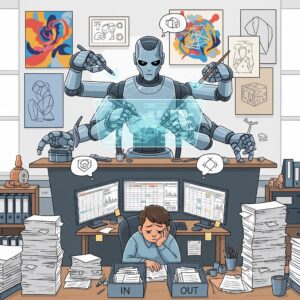
They’re not the ones with the most tools. They’re the ones who were clear about the problem they wanted to solve in the first place!
They’ve looked strategically at where time disappears on tasks that genuinely don’t need them, have built automation around those specific things and kept everything requiring trust, relationship or real creative thinking firmly in human hands.
It’s not a complicated framework. It just requires thinking before you commit.
👋 I’m Vicky – a marketing strategist and problem solver for small businesses.
I work with founders and business owners who want straight-talking marketing advice, support and honest strategy that actually fits your business.
If you’re a small business trying to work out where AI fits into your marketing (or where it really doesn’t), let’s have a chat!